You’ve unboxed your printer, leveled the bed, and printed a Benchy in PLA. Now what? The single biggest variable that determines whether your next print succeeds — or becomes a spaghetti nightmare — is your choice of 3D printer filament. Different materials behave radically differently: some warp, some string, some demand an enclosure, and some can’t be printed without a hardened nozzle.
This guide covers 18 types of 3D printer filament — from the beginner-safe PLA on every desktop to PEEK, a material that prints at 400°C and flies on jet engines. For each type, you’ll get target print temperatures, honest pros and cons, real-world applications, and a difficulty rating so you know what you’re signing up for.
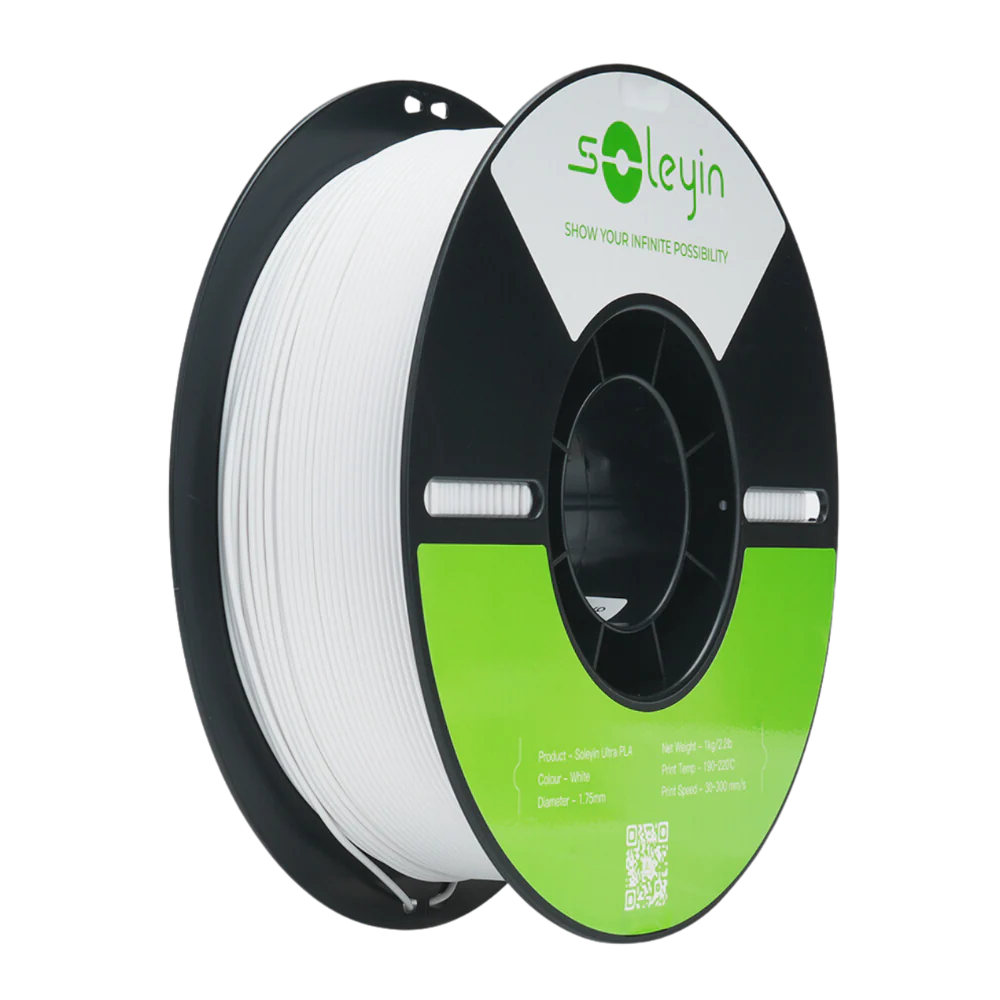
1. Standard & Beginner-Friendly Filaments
These four materials account for roughly 90% of all filament sold. If you only ever print these, you can still make most things.
PLA — Polylactic Acid
Beginner
PLA is the undisputed king of 3D printing filament. Made from renewable resources like cornstarch or sugarcane, it prints effortlessly on virtually any FDM printer — no enclosure, no heated bed (though a bed at 50–60°C helps), and almost zero warping. It’s the filament you load when you just want things to work.
Nozzle: 190–220°CBed: 0–60°CEnclosure: Not needed
+ Non-toxic, faint sweet smell + Minimal warping + Huge color/finish variety
– Brittle under load – Softens at ~60°C – Poor UV resistance
Best for: Decorative models, prototypes, toys, cosplay props, educational projects.
PETG — Polyethylene Terephthalate Glycol
Beginner-Friendly
PETG is the Goldilocks filament: nearly as easy to print as PLA, nearly as strong as ABS. It has excellent layer adhesion, good chemical resistance, and doesn’t warp much. Its slight flexibility means it absorbs impact better than PLA without snapping. The catch? It loves to stick to nozzles and can string more than PLA.
Nozzle: 210–240°CBed: 70–85°CEnclosure: Optional
+ Strong layer adhesion + Moisture + chemical resistant + Good balance of strength & ease
– Stringing/oozing – Sticks aggressively to nozzles/PEI – Scratches more easily than ABS
Best for: Mechanical parts, watertight containers, outdoor fixtures, printer upgrades, functional prototypes.
ABS — Acrylonitrile Butadiene Styrene
Intermediate
ABS is what LEGO bricks are made of — tough, impact-resistant, and able to handle higher temperatures than PLA. The trade-off: it warps. Without a heated bed (100°C+) and an enclosure to trap heat, large ABS prints will peel off the bed mid-print. It also emits styrene fumes, so ventilation is mandatory.
Nozzle: 230–260°CBed: 90–110°CEnclosure: Strongly recommended
+ High impact strength + Heat-resistant to ~100°C + Can be acetone vapor-smoothed
– Prone to warping/cracking – Emits fumes during printing – Requires enclosure for large parts
Best for: Automotive interior parts, electronic enclosures, functional prototypes, durable housings.
ASA — Acrylonitrile Styrene Acrylate
Intermediate
ASA is ABS’s outdoor cousin. It has all of ABS’s mechanical strength plus one critical advantage: UV resistance. ABS yellows and degrades in sunlight; ASA stays color-stable for years. If your print will live outside — garden fixtures, exterior enclosures, car mirror housings — ASA is the answer.
Nozzle: 230–260°CBed: 90–110°CEnclosure: Required
+ Excellent UV resistance + ABS-level mechanical strength + Weather-resistant for years
– Warps like ABS – Fumes require ventilation – More expensive than ABS
Best for: Outdoor fixtures, garden equipment, automotive exterior parts, mailboxes, weather station housings.
2. Flexible Filaments
Flexible filaments introduce rubber-like behavior to FDM printing. They absorb impact, form seals, and bend without breaking — things rigid plastic cannot do.
TPU — Thermoplastic Polyurethane
Intermediate
TPU is the most printable flexible filament. At Shore 95A (roughly a shopping cart wheel), it’s firm enough to push through an extruder without buckling yet flexible enough for phone cases, gaskets, and vibration-dampening feet. Direct-drive extruders handle it well; Bowden setups struggle and need very slow speeds.
Nozzle: 210–240°CBed: 40–60°CSpeed: 15–30 mm/s
+ Exceptional impact absorption + Great layer adhesion + Oil & abrasion resistant
– Slow print speeds required – Stringing is unavoidable – Hard on Bowden extruders
Best for: Phone cases, drone bumpers, gaskets, RC tires, vibration dampeners, wearable straps.
TPE — Thermoplastic Elastomer
Advanced
While TPU is technically a TPE variant, in the 3D printing world “TPE” usually refers to softer grades (Shore 70A–85A) — genuinely squishy like a rubber band or silicone spatula. This extreme softness makes them difficult to extrude; the filament can buckle and jam in the extruder. Largely an industrial/professional material for FDM.
Nozzle: 210–235°CBed: 40–60°CSpeed: 10–20 mm/s
+ Superior elasticity + Very soft, rubber-like feel
– Difficult to extrude reliably – Direct drive only – Very slow printing
Best for: Industrial seals, flexible tubing, specialized mechanical components, professional applications.
3. Engineering & High-Performance Filaments
These materials leave the hobbyist comfort zone. They demand high-temperature hotends, enclosures, and often hardened nozzles — but deliver mechanical properties that rival injection-molded parts.
Nylon (Polyamide)
Advanced
Nylon is tough, wear-resistant, and slightly flexible — ideal for functional mechanical parts like gears, hinges, and living springs. Its standout weakness: it absorbs moisture from the air as aggressively as a sponge. Wet nylon prints pop, fizz, and delaminate. Drying at 70–80°C for 6+ hours before every print is non-negotiable.
Nozzle: 240–280°CBed: 70–100°CEnclosure: Recommended
+ Excellent wear resistance + Slight flexibility (no snap failure) + Good chemical resistance
– Extremely hygroscopic – Requires high nozzle temps – Warps on large parts
Best for: Gears, hinges, bearings, functional mechanical parts, living hinges, cable ties.
PC — Polycarbonate
Advanced
Polycarbonate is the transparent bulletproof material. It offers extreme impact resistance and can handle continuous temperatures up to ~110°C. Printing it is challenging: nozzle temps of 260–300°C, a 100°C+ bed, and an enclosure are all required. Warping is a constant battle on anything beyond small parts.
Nozzle: 260–300°CBed: 100–120°CEnclosure: Required
+ Excellent impact resistance + High heat deflection (~110°C) + Transparent options available
– High printing difficulty – Strong warping tendency – Requires all-metal hotend
Best for: Structural components, electronic enclosures, transparent protective covers, functional prototypes.
PEEK — Polyether Ether Ketone
Industrial
PEEK sits at the absolute top of the FDM material pyramid. It withstands continuous temperatures up to 250°C, resists nearly all chemicals, and has strength-to-weight ratios that compete with metals. It also costs $500–800/kg and requires a specialized high-temperature printer with a 400°C+ hotend, 130°C+ heated chamber, and actively heated build plate. This is aerospace/medical territory.
Nozzle: 360–420°CChamber: 130°C+Printer: Specialized HT only
+ Extreme heat resistance (250°C) + Outstanding chemical resistance + Metal-replacement strength
– Prohibitively expensive – Requires specialized HT printer – Not for consumer use
Best for: Aerospace components, medical implants, oil & gas seals, high-performance industrial parts.
PEI (Ultem) — Polyetherimide
Industrial
PEI (best known by the brand name Ultem) is flame-retardant, chemical-resistant, and dimensionally stable at extreme temperatures. Like PEEK, it requires a high-temperature printer. It’s commonly found in aircraft interiors and medical devices where fire safety certification matters.
Nozzle: 350–390°CChamber: 120°C+Printer: Specialized HT only
+ Inherently flame-retardant + Excellent dimensional stability + High chemical resistance
– Extremely high printing temps – Very expensive ($300–500/kg) – Specialized printer required
Best for: Aerospace interiors, medical devices, electrical insulators, defense applications.
4. Composite & Specialty Filaments
These filaments embed fillers — carbon fiber, glass fiber, wood dust, metal powder — into a plastic base (usually PLA, PETG, or Nylon). They look and feel different from standard plastic, but almost all require a hardened steel nozzle to avoid destroying your brass one.
Carbon Fiber Reinforced Filament
Advanced
Carbon fiber filament combines chopped carbon fibers with a base polymer (PLA-CF, PETG-CF, PA-CF — Nylon-CF is the strongest variant). The result: dramatically increased stiffness, reduced weight, and far less warping than the base polymer alone. The trade-off is brittleness (it’s stiff, not tough) and the need for a hardened steel nozzle — carbon fiber is abrasive and will chew through brass in under 100g of filament.
Nozzle: 200–280°C (varies by base)Bed: Varies by base materialHardened nozzle: Required
+ Exceptional stiffness-to-weight + Low warping vs. base polymer + Matte, professional finish
– Abrasive — hardened nozzle required – Brittle (stiff ≠ tough) – Premium price ($40–80/kg)
Best for: Drone frames, RC car components, structural brackets, jigs & fixtures, lightweight mechanical parts.
Glass Fiber Reinforced Filament
Intermediate
Similar concept to carbon fiber but uses glass fibers. It provides enhanced strength, rigidity, and dimensional stability at a lower price than CF variants. Still abrasive — hardened nozzle required. Often used for reinforced prototypes and mechanical parts where CF’s premium isn’t justified.
Nozzle: 220–270°CBed: Varies by baseHardened nozzle: Required
+ Increased rigidity & strength + More affordable than CF
– Abrasive (hardened nozzle required) – Heavier than carbon fiber
Best for: Reinforced prototypes, mechanical parts, functional jigs, cost-sensitive strength applications.
Wood-Filled Filament
Beginner
Wood PLA contains 20–30% real wood fibers suspended in a PLA base. It prints roughly like PLA, smells faintly of wood while printing, and can be sanded, stained, and painted like real wood. Varying the print temperature changes the shade (hotter = darker), letting you simulate wood grain with temperature towers. Use a 0.6mm+ nozzle to reduce clogging.
Nozzle: 190–220°CBed: 50–60°CNozzle size: 0.5mm+ recommended
+ Sandable, stainable, paintable + Authentic wood look & smell + Prints similarly to PLA
– Can clog small nozzles – Weaker than pure PLA
Best for: Artistic prints, decorative pieces, cosplay props, architectural models, furniture accents.
Metal-Filled Filament
Intermediate
Metal-filled filaments mix fine metal powder (copper, bronze, steel, iron) into PLA at 30–80% loading by weight. The result is a dense, weighty part with a metallic sheen that can be polished, brushed, or patinated. It’s highly abrasive — hardened steel nozzle is mandatory. The parts aren’t solid metal (they’re still mostly plastic), but the look and heft are convincing.
Nozzle: 200–230°CBed: 50–60°CHardened nozzle: Required
+ Authentic metallic look & weight + Polishable and patinatable
– Very abrasive (hardened nozzle only) – Brittle; weaker than regular PLA – Expensive ($50–120/kg)
Best for: Sculptures, display models, jewelry prototypes, historical replicas, prop making.
Glow-in-the-Dark Filament
Beginner
Glow-in-the-dark filament contains strontium aluminate phosphors in a PLA or PETG base. It charges under light and glows green (or blue, depending on formulation) for hours. Important caveat: the phosphor particles are extremely abrasive — more so than wood or even some carbon fiber filaments. A hardened nozzle is not optional here.
Nozzle: 190–220°CBed: 50–60°CHardened nozzle: Required
+ Luminous effect, long afterglow + Prints like standard PLA
– Highly abrasive (hardened nozzle only) – Limited color range
Best for: Safety markers, novelty toys, Halloween decorations, custom light switch covers, signage.
Silk PLA
Beginner
Silk PLA is standard PLA blended with elastomeric additives that produce a glossy, pearlescent surface finish. It hides layer lines remarkably well and gives models a polished, premium look straight off the printer. The downside: the same additives that create the sheen also reduce layer adhesion. Silk PLA parts are weaker and more brittle than regular PLA — don’t use them for anything load-bearing.
Nozzle: 200–225°CBed: 50–60°CEnclosure: Not needed
+ Glossy, eye-catching finish + Hides layer lines well + Prints as easily as PLA
– Reduced layer adhesion – Weaker than standard PLA – Inconsistent between brands
Best for: Display models, decorative vases, trophies, artistic sculptures, jewelry stands.
5. Support & Special-Purpose Filaments
These filaments aren’t for making final parts — they’re for making complex geometry possible. Used as dissolvable or breakaway support material in dual-extruder setups.
PVA — Polyvinyl Alcohol (Water-Soluble)
Advanced
PVA is the support material for when you absolutely need the underside to be perfect. Print your model in PLA and the supports in PVA, then submerge the entire part in water. The PVA dissolves completely, leaving a clean surface with zero scarring. It’s magical — but PVA is also expensive ($60–100/kg), moisture-obsessed (store it in a sealed dry box always), and requires a dual-extruder printer.
Nozzle: 180–220°CBed: 50–60°CDual extruder: Required
+ Perfect support removal + Enables impossible geometries
– Very expensive – Extremely moisture-sensitive – Dual extruder required
Best for: Complex models with internal cavities, intricate overhangs, architectural models requiring flawless surfaces.
HIPS — High Impact Polystyrene
Advanced
HIPS is the support material counterpart to ABS. It dissolves in limonene (citrus-based solvent), not water, and can also be used as a standalone printing material for lightweight functional parts. Like PVA, it demands a dual-extruder setup and good ventilation — limonene is pleasant-smelling but you still don’t want to huff it all day.
Nozzle: 230–240°CBed: 90–110°CDual extruder: Required for support use
+ Pairs perfectly with ABS + Dissolves cleanly in limonene + Can be used as standalone material
– Dual extruder required for support – Limonene solvent cost – Warping similar to ABS
Best for: ABS support structures, lightweight functional parts, complex engineering prototypes.
Master Comparison Table
| Filament | Nozzle °C | Bed °C | Strength | Flex | Heat Res. | Difficulty | Best For |
|---|---|---|---|---|---|---|---|
| PLA | 190–220 | 0–60 | ⭐⭐ | Rigid | Low | Easy | Prototypes, decorative, toys |
| ABS | 230–260 | 90–110 | ⭐⭐⭐⭐ | Rigid | High | Moderate | Functional parts, automotive |
| PETG | 210–240 | 70–85 | ⭐⭐⭐⭐ | Semi | Moderate | Easy | Mechanical, outdoor, containers |
| ASA | 230–260 | 90–110 | ⭐⭐⭐⭐ | Rigid | High | Moderate | Outdoor, UV-exposed parts |
| TPU | 210–240 | 40–60 | ⭐⭐⭐ | Flexible | Moderate | Moderate | Phone cases, gaskets, wearables |
| TPE | 210–235 | 40–60 | ⭐⭐⭐ | Very elastic | Moderate | Hard | Industrial seals, tubing |
| Nylon | 240–280 | 70–100 | ⭐⭐⭐⭐⭐ | Slight | High | Hard | Gears, hinges, mechanical |
| PC | 260–300 | 100–120 | ⭐⭐⭐⭐⭐ | Semi | Very high | Hard | Structural, transparent covers |
| PEEK | 360–420 | 130+ | ⭐⭐⭐⭐⭐ | Rigid | Extreme | Industrial | Aerospace, medical |
| PEI (Ultem) | 350–390 | 120+ | ⭐⭐⭐⭐⭐ | Rigid | Extreme | Industrial | Aerospace, flame-retardant |
| Carbon Fiber | 200–280 | Varies | ⭐⭐⭐⭐ | Stiff | Varies | Hard | Drones, robotics, brackets |
| Glass Fiber | 220–270 | Varies | ⭐⭐⭐⭐ | Stiff | Varies | Moderate | Reinforced prototypes |
| Wood-Filled | 190–220 | 50–60 | ⭐⭐ | Rigid | Low | Easy | Art, decoration, cosplay |
| Metal-Filled | 200–230 | 50–60 | ⭐⭐ | Rigid/brittle | Low | Moderate | Sculptures, display, jewelry |
| Glow-Dark | 190–220 | 50–60 | ⭐⭐ | Rigid | Low | Easy | Safety, novelty, signage |
| Silk PLA | 200–225 | 50–60 | ⭐ | Slight | Low | Easy | Display models, trophies |
| PVA | 180–220 | 50–60 | ⭐⭐ | Soft | Low | Hard | Water-soluble supports |
| HIPS | 230–240 | 90–110 | ⭐⭐⭐ | Rigid | Moderate | Hard | ABS supports, lightweight parts |
How to Choose the Right 3D Printer Filament
With 18 options, the decision can feel overwhelming. But choice narrows quickly when you ask three questions:
The Three-Question Filament Filter
- What’s the part going to do? Decorative → PLA or Silk PLA. Functional → PETG, ABS, or Nylon. Outdoor → ASA. Flexible → TPU. Structural/lightweight → Carbon Fiber.
- What can your printer handle? Do you have an all-metal hotend? (PC/Nylon need it.) An enclosure? (ABS/ASA require it.) A hardened nozzle? (Carbon fiber, glow, and metal-fill destroy brass.) Dual extruder? (PVA/HIPS supports need it.)
- What’s your experience level? If you’ve only printed PLA, don’t jump to Nylon or PC. Graduate through PETG → TPU → ABS/ASA → Nylon → PC. Each step teaches you something the previous material didn’t.
Quick Decision Guide
“I want easy, reliable prints.”
→ PLA or PETG. No enclosure, no drama, wide printer compatibility.
“I need strong functional parts.”
→ PETG for everyday strength. ABS or Nylon for high-stress parts.
“It has to live outdoors.”
→ ASA (UV-resistant) or PETG (good-enough UV for most cases). Never PLA.
“I want rubber-like parts.”
→ TPU 95A (direct drive). Bowden? Stick to TPU 98A or harder.
“Lightweight + super stiff.”
→ Carbon Fiber Nylon (PA-CF). Hardened nozzle required.
“It needs to look amazing.”
→ Silk PLA for gloss. Wood for natural look. Metal-fill for heft.
Storage & Handling Tips
Poor filament storage is the #1 cause of “my printer suddenly prints terribly.” Most 3D printer filaments are hygroscopic — they absorb moisture from the air. Wet filament hisses, spits, and produces weak, bubbly prints.
Storage Best Practices
- Seal it. Store every spool in an airtight container or vacuum-sealed bag with fresh silica gel desiccant. Ziploc bags with the air squeezed out are the bare minimum.
- Dry it. Before printing Nylon, PC, PVA, or any filament that’s been open for more than a week, run it through a filament dryer (or food dehydrator) at the manufacturer’s recommended temperature for 4–8 hours.
- Print from a dry box. For Nylon and PVA especially, keep the spool in a sealed dry box during printing. These materials can absorb enough moisture mid-print to cause problems.
- Label everything. Mark each spool with the date you opened it and the material type. An unlabeled spool is a mystery — and guessing wrong can mean a ruined nozzle or a failed print.
- Don’t trust “factory sealed.” Vacuum-sealed doesn’t mean dry. Manufacturers package in ambient conditions; always dry a new spool of Nylon, PC, or PVA before its first use.
- Protect from light & heat. Store spools in a cool, dark place. UV degrades most polymers over time, and heat can soften or deform the filament on the spool.
Frequently Asked Questions
Q: What is the strongest 3D printing filament?
For consumer printers, Nylon and Polycarbonate (PC) are the strongest readily available options. Carbon fiber reinforced Nylon (PA-CF) adds stiffness on top of Nylon’s toughness. At the industrial level, PEEK and PEI outperform everything but require specialized printers.
Q: Which filament is easiest for beginners?
PLA without question. It prints at low temperatures, doesn’t require an enclosure, has minimal warping, and is forgiving of imperfect settings. Once you’re comfortable with PLA, PETG is the natural next step.
Q: What filament is best for outdoor use?
ASA is purpose-built for outdoor use with excellent UV resistance. PETG is a solid budget alternative — it won’t last as long as ASA in direct sun but handles moisture and temperature swings well. Never use PLA outdoors; it will deform in direct sunlight within hours.
Q: Can all filaments be used with any 3D printer?
No. PLA and PETG work on nearly every FDM printer. ABS/ASA require a heated bed (90°C+) and an enclosure. Nylon, PC, and composites need high-temperature hotends (260°C+). PEEK and PEI demand specialized industrial printers. Always check your printer’s maximum nozzle temperature and bed temperature against the filament’s requirements.
Q: Do I really need a hardened nozzle for carbon fiber filament?
Yes. Carbon fiber is abrasive and will widen a brass nozzle’s bore within 50–100g of filament — ruining dimensional accuracy and eventually destroying the nozzle entirely. Hardened steel or ruby-tipped nozzles are mandatory for any abrasive filament (CF, glass fiber, glow-in-the-dark, metal-fill).
Q: Why does my filament snap or break during printing?
Three likely causes: (1) Moisture — wet filament becomes brittle. Dry it. (2) Age/degradation — PLA becomes brittle after prolonged exposure to humidity. (3) Bend radius — the filament path is too tight, especially on Bowden setups. Check for sharp bends in the PTFE tube or filament guide.
Q: Is 3D printer filament food-safe?
Most are not certified food-safe, even if the base polymer is. FDM printing creates microscopic gaps between layers that trap bacteria. The pigments and additives in colored filament are rarely food-grade. If you need food-contact parts, use a food-safe filament (natural PLA or PETG with FDA documentation), print with a stainless steel nozzle, and coat the part with a food-safe epoxy or sealant.
The Bottom Line
The type of 3D printer filament you choose doesn’t just affect how your print looks — it determines whether it works. PLA makes beautiful things that break when you drop them. PETG makes strong things that survive the dishwasher. TPU makes things that bounce. Nylon makes gears that outlast your printer. And PEEK makes parts for jet engines.
Start with PLA. Move to PETG when you need strength. Add TPU when you need flexibility. Try ABS or ASA when heat or UV matters. Graduate to Nylon and composites when you’ve mastered the basics. Each material teaches you something — and by the time you’ve printed them all, you’ll know exactly which spool to reach for before you even open the slicer.
One last tip: Buy small sample coils before committing to a full 1kg spool of any new filament type. A $5 sample saves you from a $35 spool of misery.
Disclaimer: Print temperature recommendations are starting points based on widely tested community practices as of mid-2026. Always consult your filament manufacturer’s specific technical data sheet. Printer compatibility varies — check your hardware specifications before attempting high-temperature or abrasive filaments.